A conversation about inspiration, process, wildlife art and the discipline behind a creative practice.
How did you first get into painting? Was there a particular influence?
Amanda Drage: I’ve always been creative. Like most people, I started with pencils and crayons as a child. But when it came to oils, I actually resisted them for quite a long time. My first experience was with those paint-by-numbers kits. The little pots of quite poor-quality oil paint and I remember thinking, “This is awful, I don’t want to use oils again.” But later on, I came back to them and realised how different they could be. Now I absolutely love working in oils, I couldn’t imagine not using them. More broadly, art has just always been something I’ve done. There’s never really been a question of not doing it. Over time, I’ve just become more interested in exploring different materials and ways of working.
Did you formally study art?
Amanda Drage: I did art at A-level, but I didn’t go on to study it at university. At the time, I found it quite challenging, not because I didn’t enjoy art, but because I was very focused on what I wanted to do, which was drawing animals, particularly horses. The course required a lot of different approaches, studying other artists, working from still life, focusing on theory and sketchbooks and that didn’t really resonate with me at the time. It’s funny, because now I enjoy some of those things, like painting flowers, but back then it didn’t connect with me in the same way. I didn’t do badly, but I didn’t particularly excel either.
What drives you as an artist? Do you have specific ambitions?
Amanda Drage: Not really in a traditional sense. I don’t think in terms of a final goal or endpoint. For me, it’s an ongoing practice, it’s just what I do. Of course, it’s always nice when opportunities come from the work, but even if they didn’t, I’d still be painting.
Inspiration and Subject Matter
What subjects do you most enjoy painting?
Amanda Drage: Birds are probably my favourite. There’s such a vast range, you could spend a lifetime painting them and still not cover everything. I’ve also really enjoyed working on big cats recently, and I do love painting horses as well. Horses were actually my first subject, I used to draw them constantly when I was younger.
Do you prefer to work from your own reference photos?
Amanda Drage: Yes, wherever possible. I try to visit places like bird parks or zoos and take my own photos. It’s something I’d like to do more of. I used to sketch from life quite a lot, which is great practice, but I find photographs more useful as reference material when it comes to painting. Taking your own photos also means you can compose the image exactly how you want it, capturing the light, angle, and detail in a way that suits your vision.
How do you decide on the pose or composition of a piece?
Amanda Drage: It’s often instinctive. There’s usually something about an image that stands out, often the light. That’s the most important factor for me. After that, it’s the pose. I tend to look for something a bit more unusual or dynamic, something with a strong silhouette or a slightly different perspective. If both the lighting and the pose work, then I know I’ve got the basis for a painting.
Building a Painting
Do you follow a set process or stages when creating a painting?
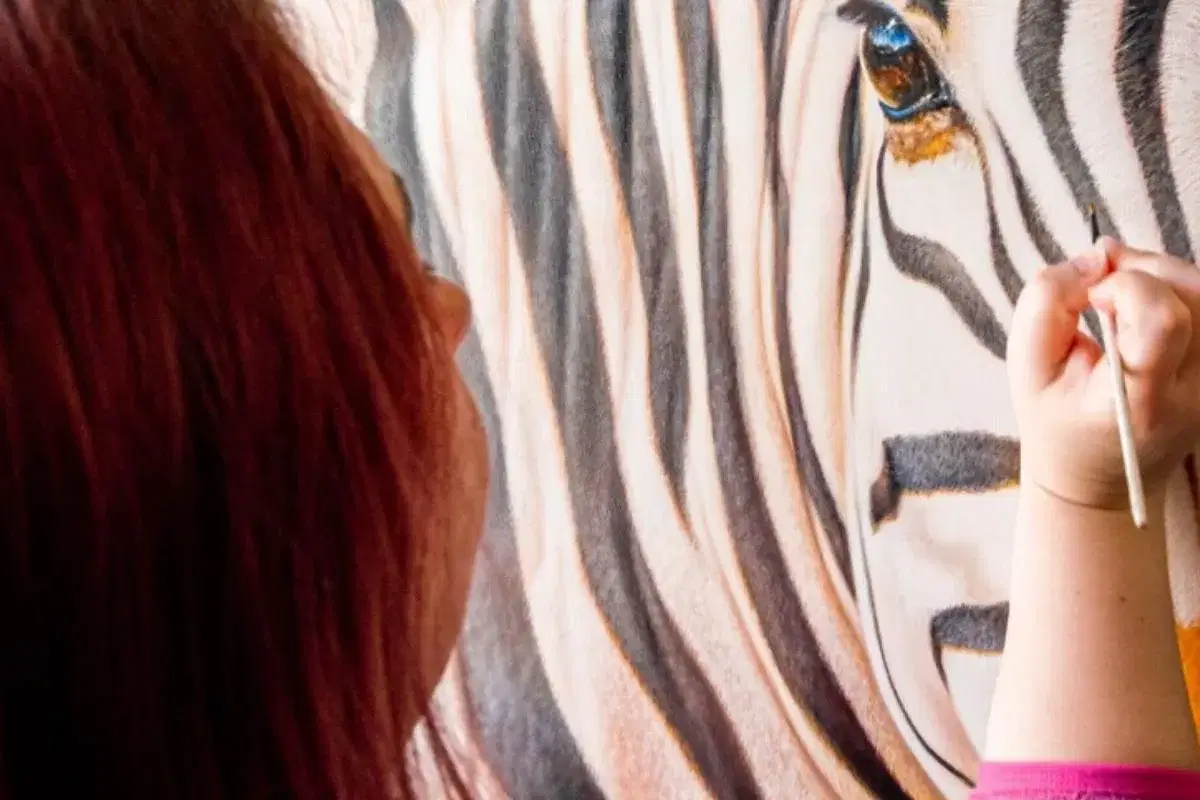
Amanda Drage: Yes, there’s definitely a structure. It starts with gathering reference material and building the composition digitally. Once that’s finalised, I transfer the drawing to the canvas. Then comes the underpainting, usually in a single colour, just to establish tone and form. After that, it’s a gradual build-up in oils. Each layer adds more refinement and detail. The painting evolves step by step, becoming more resolved as it goes.
Do you paint the background first?
Amanda Drage: No, not usually. My process normally starts before I even touch the canvas. I’ll create a rough composition in Photoshop, almost like a mock-up, especially if I’m working from multiple reference images. Once I’m happy with that, I transfer the drawing to the canvas and begin by blocking in the subject using acrylic. It’s quite loose at that stage, just a tonal map to establish placement and structure. From there, I build it up in oils, layer by layer. The background comes later. I don’t tend to start with it, although it can vary depending on the painting. Generally, though, I prefer to establish the subject first and then develop the background alongside it as the piece evolves.
Is that approach common among artists?
Amanda Drage: I think it really depends on the medium and the individual artist. For me, it’s about getting the subject to a certain stage first, something solid enough to respond to, then bringing in the background. A lot of the time, I’ll move back and forth between the two, gradually building them up together so they feel cohesive.
Studio Life and Working Habits
Thinking more generally about your practice, do you need to be in a specific environment to work? Do you have to be in your studio, or have certain things in place to feel “in the zone”?
Amanda Drage: Ideally, yes. I have a small studio at home, and it’s really important to have that dedicated space. It’s not huge, but it’s just about big enough to fit a couple of larger paintings, and everything is set up how I need it. When everything’s in place, it makes it much easier to get straight into the work. There’s something about having that consistent environment that helps you focus, it puts you in the right mindset straight away.
Do you structure your time when you’re painting? For example, working in focused blocks?
Amanda Drage: I’ve noticed I’m much more focused in the afternoon. Mornings tend to get taken up with emails and general admin, so the real painting happens after lunch. That said, I do have to be quite disciplined about taking breaks. When you’re in the flow, it’s very easy to just keep going, you don’t really want to stop. However I’ve learned that stepping away is important, otherwise you can burn out without realising it.
Do you ever have moments where you need to walk away from a piece completely?
Amanda Drage: Yes, definitely. Although interestingly, painting can also be a way of switching off from other things, it’s quite absorbing. When I do need a break, I often don’t step away from art entirely. Instead, I’ll switch to another piece. That change of focus can be really helpful. With larger paintings especially, you can hit a point where you’re stuck, you’re not sure how to move forward. Working on something smaller or different can reset your thinking. Then when you come back, you often see the solution much more clearly. There was actually one painting I had to leave for about six months. I just couldn’t resolve it. But eventually something clicked, and I went back and finished it in a couple of days.
Materials, Technique and Problem Solving
What materials do you typically work with?
Amanda Drage: Oils are my main medium, but I often use acrylic underneath as a base layer. I also work with pastels, both soft pastels and pastel pencils as well as coloured pencils. Recently, I’ve been experimenting a bit more with ink and Inktense materials, which are an interesting mix between watercolour, ink, and something almost like crayon. I’ll generally try most things. The only medium I haven’t used extensively is watercolour. I’ve experimented with it, but I haven’t fully explored it yet. I think it’s one of those things I’ll come back to at some point, maybe in a few years.
How do you handle mistakes when working in oils?
Amanda Drage: That’s one of the advantages of oil paint – you have flexibility. If something isn’t working, you can wipe it away while it’s still wet. Even once it’s dry, you can paint over it. It might slow the process down, but it’s very forgiving in that sense.
Have any of your recent works been particularly challenging?
Amanda Drage: Every painting has its challenges. With the lion, for example, the mane was quite difficult, especially capturing the light hitting all the individual strands. With the lioness, the challenge was more about colour. It took a long time for everything to come together. It wasn’t until the final layers, when I applied the glazes, that the whole painting unified in the way I’d been aiming for.
If the reference images aren’t perfect, do you rely on your own creativity to fill in the gaps?
Amanda Drage: Yes, absolutely. I usually ask for a selection of photos rather than just one. I’ll choose a main image to base the portrait on, but then use the others to support it, whether that’s for detail, lighting, or understanding the structure better. I actually enjoy combining references. For example, with some of my wildlife pieces, I might take the head from one image and the body or mane from another. It allows me to create something that feels more complete or expressive than any single photo might offer.
How do you approach commissioned work, particularly with deadlines?
Amanda Drage: Most of my commissions so far have been pet portraits, which are relatively structured. I usually work in pastel for those, as that’s what people tend to come to me for. They’re generally more straightforward compositions, often with simple or minimal backgrounds so there’s less to get stuck on. The main challenge comes when the reference photos aren’t ideal. Since I’m working from images people provide, sometimes they’re not very detailed or well-lit. In those cases, it can be tricky to interpret certain areas, but I work through it.
Knowing When a Painting is Finished
Is there a part of the process you enjoy most?
Amanda Drage: I really enjoy the early stage, when you’re putting the idea together and imagining what it’s going to become. There’s a lot of excitement in that phase. The middle can be more difficult. That’s often when the painting doesn’t quite feel like it’s working yet, and you have to push through. Then towards the end, everything starts to come together, and that’s incredibly satisfying, especially when you finally achieve the effect you’ve been aiming for.
Do you instinctively know when a piece is finished?
Amanda Drage: Most of the time, yes. There can be moments of doubt where you think it might be finished but something doesn’t quite sit right. But when it really is done, there’s a sense of clarity about it – you just know.
Do you feel a connection to the subjects you paint?
Amanda Drage: Yes, in a way, especially with subjects that have a strong gaze. For example, with the lioness, she’s looking directly at you, so there’s a real sense of presence. When you spend that much time working on something, you do start to feel a connection to it.
Do you ever find it hard to let go of a finished piece?
Amanda Drage: Sometimes. There’s always that temptation to keep adjusting things, even when you know it’s finished. But I think part of being an artist is recognising when to stop, when the painting has reached the point it needs to.
Sketches, Time and Favourite Works
You produce a lot of sketches, do they always develop into full paintings?
Amanda Drage: Not always. A lot of the sketches I’m doing at the moment are standalone pieces in their own right. That said, they often act as a springboard. Even if I don’t directly turn a sketch into a painting, it might lead to another idea later on. They’re part of the process, helping me explore composition, form, or mood before committing to a larger piece.
Are there any questions you get asked regularly?
Amanda Drage: The most common one is definitely, “How long did that take?” It’s understandable, but it’s quite a difficult question to answer. It’s not just about the hours spent on the final piece, it’s everything that comes before it as well. The years of practice, the experimentation, the learning, it all feeds into the work. People are also often interested in where inspiration comes from, or how I choose my subjects, which you’ve already touched on.
Staying on that point, do some pieces take significantly longer than others?
Amanda Drage: Yes, definitely. Not necessarily half the time, but there can be quite a difference. Sometimes a painting comes together quite naturally, you don’t run into too many problems, and the process flows. Other times, you might get stuck on a particular section and spend a lot of time trying to resolve it. For example, with “Presence,” the black tones seemed to come together relatively quickly. The zebra as well, I expected that to take longer, but it progressed quite smoothly. On the other hand, some pieces require more time and patience. You can’t rush them, you just have to let them take as long as they need.
Do you have a favourite piece from your work?
Amanda Drage: That’s a difficult question. It often tends to be the most recent piece, simply because it’s fresh in your mind. At the moment, I’m quite fond of the lioness I’ve just finished. But that might change over time, it’s quite common to feel most connected to whatever you’ve just completed.
Explore Amanda’s artwork at Lorimer Gallery
Discover Amanda’s artwork at Lorimer Gallery, where her distinctive style and creative vision are showcased alongside a carefully curated collection of contemporary art.
Amanda’s work captures imagination and emotion through colour, texture and composition, creating pieces that inspire connection and conversation. Whether you’re an experienced collector or simply looking for a piece that speaks to you, her collection offers something truly special.
View Amanda’s collection online, or why not plan a visit to Lorimer Gallery and see her work in person?